We are happy to share that FlowMM has been accepted to the EMNLP 2026 Main Conference.
Multimodal large language models keep key and value states for long text and many visual tokens. As context grows, this KV cache becomes a major memory and decoding bottleneck. Eviction saves memory by deleting entries, but can remove information that later reasoning still needs. Merging is less destructive, yet a single similarity rule across every layer can mix visual and textual states before their semantics are ready to be combined.
FlowMM treats compression as an information-flow alignment problem. It observes how visual and textual tokens interact at each layer, selects a matching merge strategy for that layer, and protects task-sensitive tokens from risky consolidation.
Why static merging breaks multimodal context
Cross-modal interaction is not uniform across model depth:
- Shallow layers are mostly intra-modal. Visual and textual tokens are still developing modality-specific representations, so premature cross-modal merging can cause semantic confusion.
- Deeper layers become more cross-modal. Once heterogeneous tokens exchange more attention, cross-modal merging can consolidate shared context effectively.
- Alignment matters. Applying the opposite strategy at each stage sharply degrades performance, even when the cache budget stays unchanged.
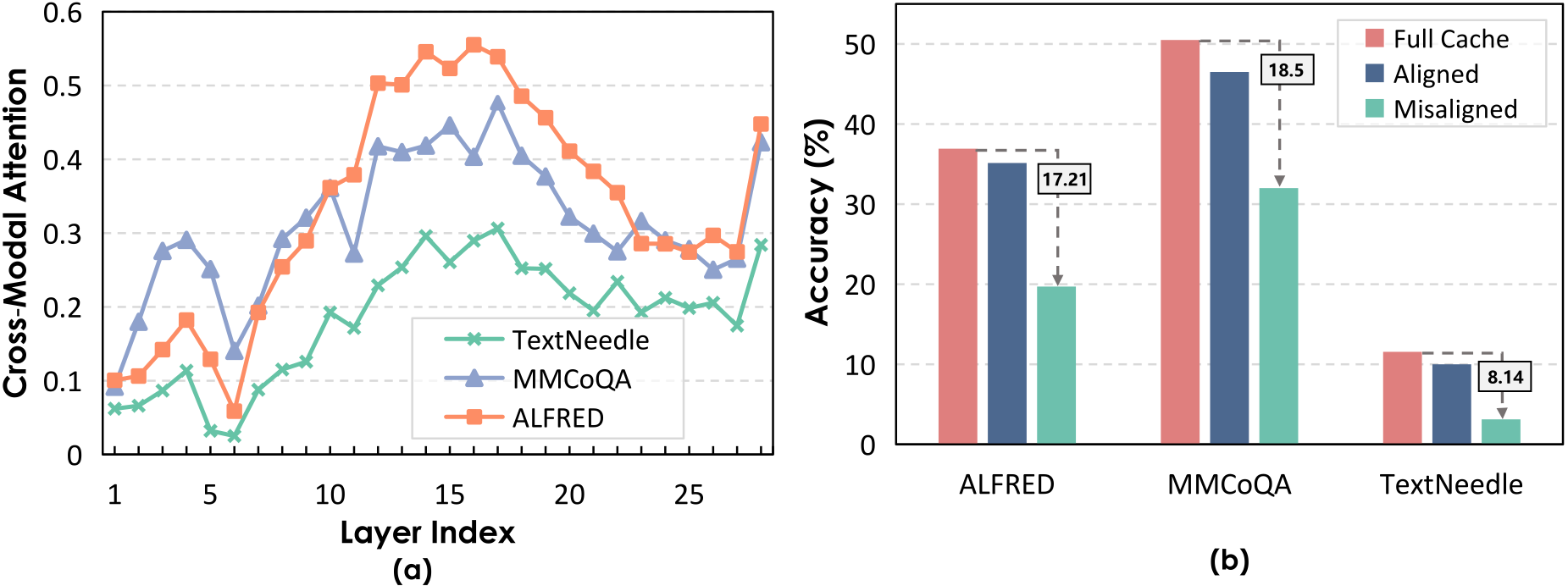
Across ALFRED, MMCoQA, and TextNeedle, flow-aligned merging remains close to the full cache. Misaligned merging loses 17.21, 18.5, and 8.14 points, respectively, relative to full-cache performance. The result suggests that deciding how to merge is as important as deciding which tokens to retain.
FlowMM in one pass
FlowMM combines two coordinated ideas:
- Measure cross-modal information flow. For each layer, FlowMM computes the share of attention exchanged between visual and textual tokens.
- Choose a layer-specific merge strategy. Layers with limited cross-modal interaction merge within each modality; layers with strong interaction can merge across modalities.
- Estimate token sensitivity. A small set of task-proximal proxy tokens identifies states that strongly influence the current response.
- Match safely. Similar low-sensitivity tokens are merged into important pivot tokens, while high-sensitivity states are protected from consolidation.
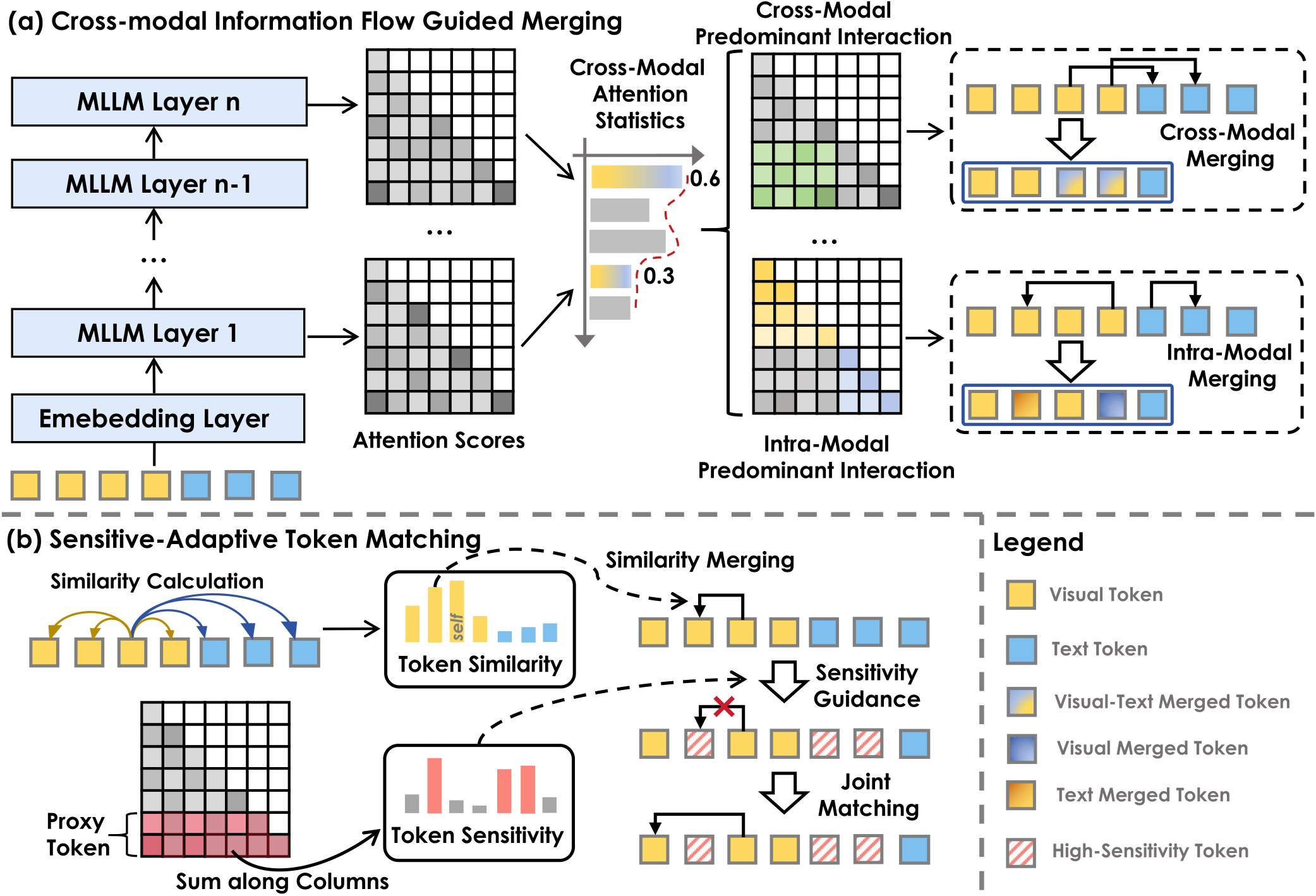
The complete procedure is training-free and plug-and-play. It adapts the compression pattern during inference without fine-tuning the underlying multimodal model.
Performance at a 20% cache budget
We evaluate FlowMM on seven MileBench tasks with three different multimodal backbones. All compressed methods retain the same 20% cache budget.
| Backbone | Full cache average | Best compressed baseline | FlowMM |
|---|
| Qwen2.5-VL-7B | 32.44 | 27.72 | 30.37 |
| InternVL2.5-8B | 27.97 | 26.06 | 27.85 |
| MobileVLM-V2-3B | 12.99 | 11.07 | 12.32 |
FlowMM is the strongest compressed-cache method on the average score for all three backbones. On InternVL2.5-8B, it stays within 0.12 points of the full-cache average while using only 20% of the cache. On Qwen2.5-VL-7B TextNeedle, it improves by 5.31 points over the strongest eviction baseline.
Robustness across cache budgets
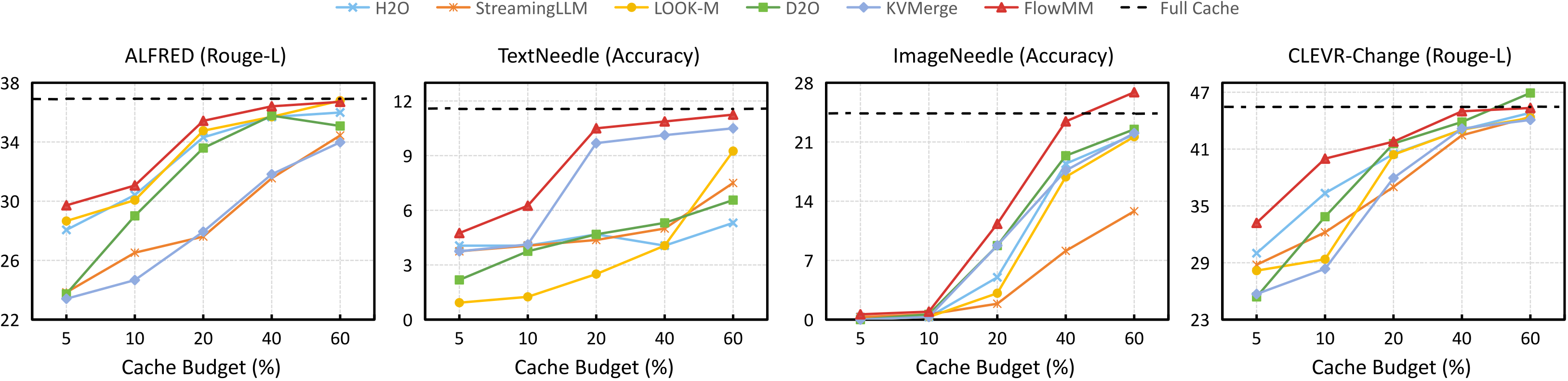
FlowMM remains effective from a 5% to 60% cache budget. On TextNeedle, its 20% configuration outperforms eviction-based methods retaining 60% of the cache. At a 40% budget, it approaches full-cache performance across the evaluated tasks, while at 60% it can even surpass full caching on ImageNeedle.
Speed and memory
The efficiency measurements use one NVIDIA A100 GPU and average 20 randomly sampled examples.
| Cache budget | Decoding latency | KV-cache GPU memory |
|---|
| Full cache (100%) | 29.08 ms/token | 2.06 GiB |
| 50% | 23.04 ms/token | 1.05 GiB |
| 35% | 19.18 ms/token | 0.74 GiB |
| 20% | 17.35 ms/token | 0.44 GiB |
| 5% | 15.81 ms/token | 0.13 GiB |
At the most aggressive measured setting, FlowMM reduces KV-cache memory from 2.06 GiB to 0.13 GiB and cuts per-token latency from 29.08 ms to 15.81 ms. Across the evaluated configurations, this corresponds to an 80–95% memory reduction and approximately 1.3–1.8× decoding speedup while maintaining competitive task performance.
Takeaway
Multimodal KV-cache compression should respect how information moves between modalities and across layers. FlowMM aligns merging with that flow, then uses sensitivity-aware matching to preserve the states that matter most. The result is a simple inference-time method that makes long multimodal contexts substantially more memory- and latency-efficient without retraining the model.
Further reading